What law firms said out loud at Legal AI New York.
Six themes that kept coming up across two days of sessions, then two points from every talk. I spoke on the Day 1 governance panel and took notes on the rest.
By Robbie Allen · Published November 13, 2026 · Legal AI New York, an Inside Practice event, November 11 to 12, 2026
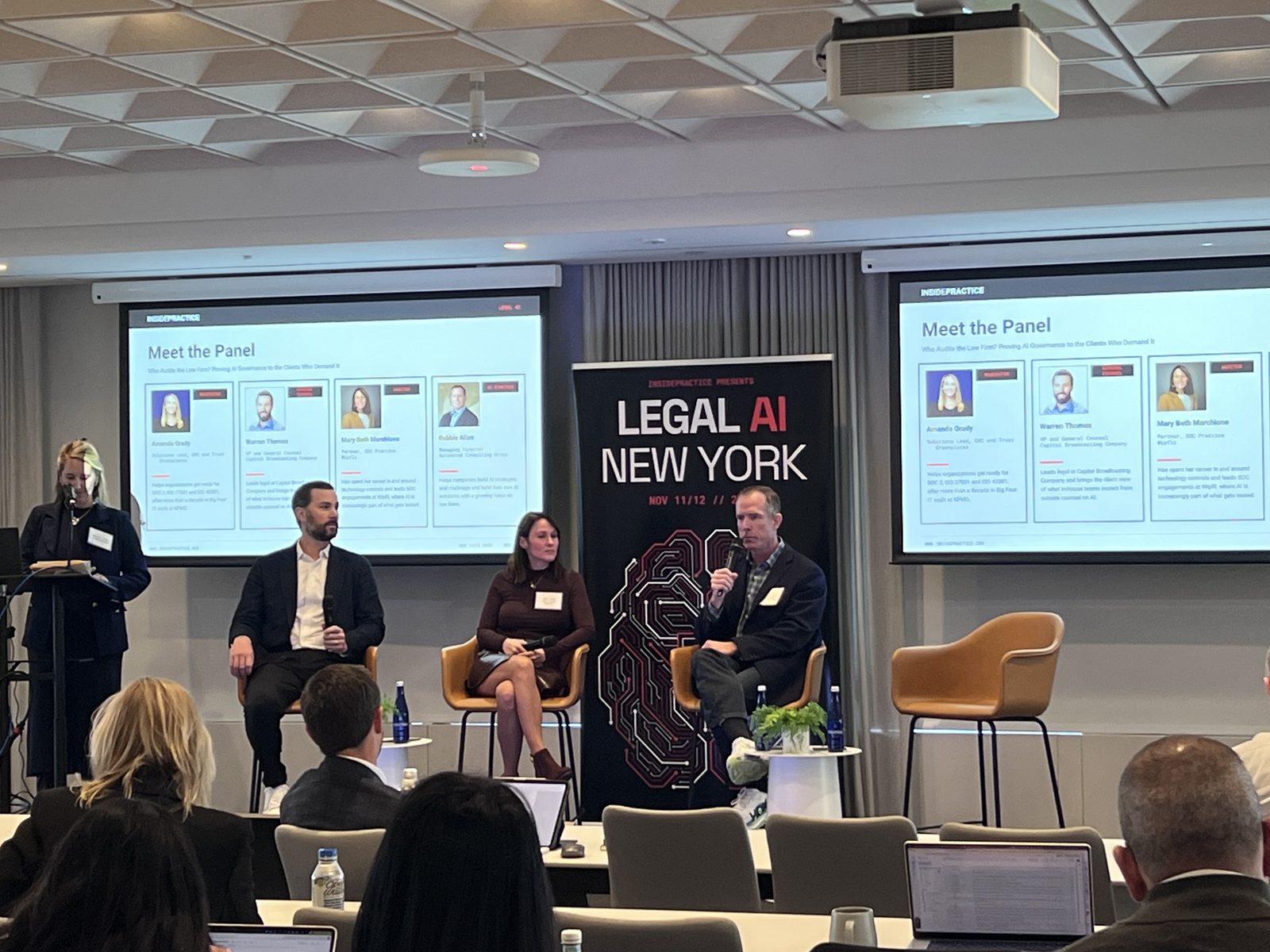
The Day 1 governance panel: Amanda Grady, Warren Thomas, Mary Beth Marchione, Robbie Allen.
Six things the room kept saying
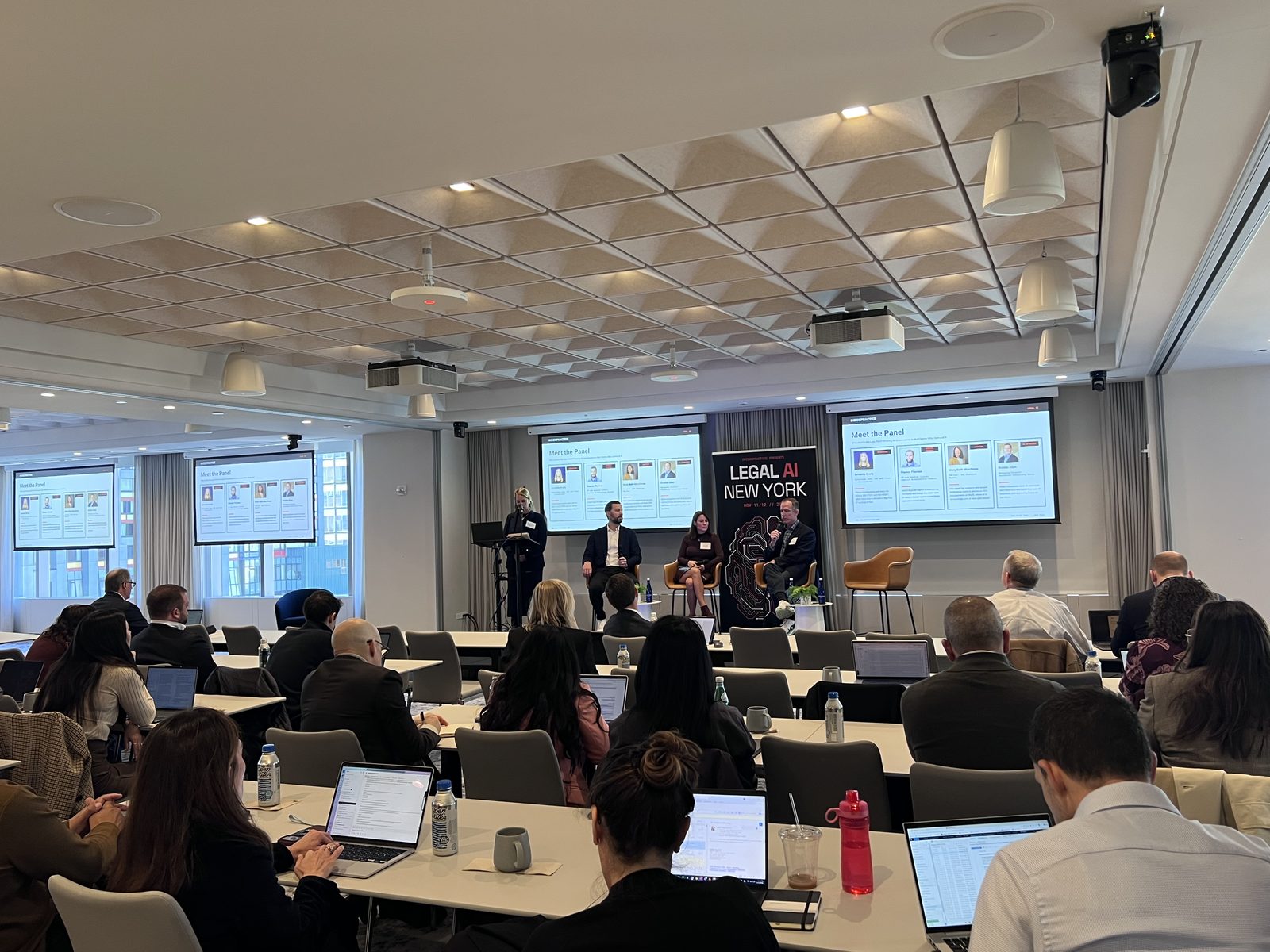
Thirteen sessions, one room, more than 300 registered, mostly innovation, knowledge, and practice technology roles at larger firms. These ideas came up again and again, whoever was on stage.
1Strategy
Year two asks what year one skipped.
Year one was buying tools. Now renewals are due, pricing is moving to consumption, and the question is which business problem each tool solves. Thomson Reuters' survey: more than nine in ten professionals say their organization falls short of what AI could deliver. With a clear strategy, two-thirds say AI meets expectations.
2Usage and adoption
A seat is not adoption.
Usage is logins. Adoption is a change in how someone works. Most firms measure the first and report the second. Lawyers who are underwater do not learn new tools, so check hours before scheduling training. Group roadshows draw silence. One-on-ones run over.
3Training and talent
Prompt libraries are out. Judgment is in.
Last year’s prompt decks are mostly useless now. Give the tool more context, iterate, talk instead of type, and do the task by hand first so you know what good looks like. The scarce hire knows how legal work gets done, can build, and can get people to change.
4Agents and building your own
A lot of agentic work is data work.
The showcase case study used agents to turn 70 to 80 vendor spreadsheet formats into one taxonomy. Thomson Reuters tests each new model with 5,000 test questions, several times a week. The failure mode has shifted from invented citations to misattribution.
5Billing and client value
Clients measure outcomes. Firms report inputs.
Asked how firms should recover AI spend, a room voting as general counsel chose “my bill should go down” first. Only 31% of respondents in a summer survey had seen profit gains from AI-enabled matters. What clients still pay for is judgment, market knowledge, and accountability.
6Governance and proof
Policy says what you intend. Evidence says what happened.
A general counsel who works with 30 to 40 firms said he couldn’t think of one that had raised AI governance with him unprompted, and missing proof is becoming an RFP disqualifier. Clients want SOC 2 Type 2 because it tests operation over time. A third of professionals use tools their organization never approved. And once a firm gives clients a tool it built, as I put it on stage, you’re the vendor now.
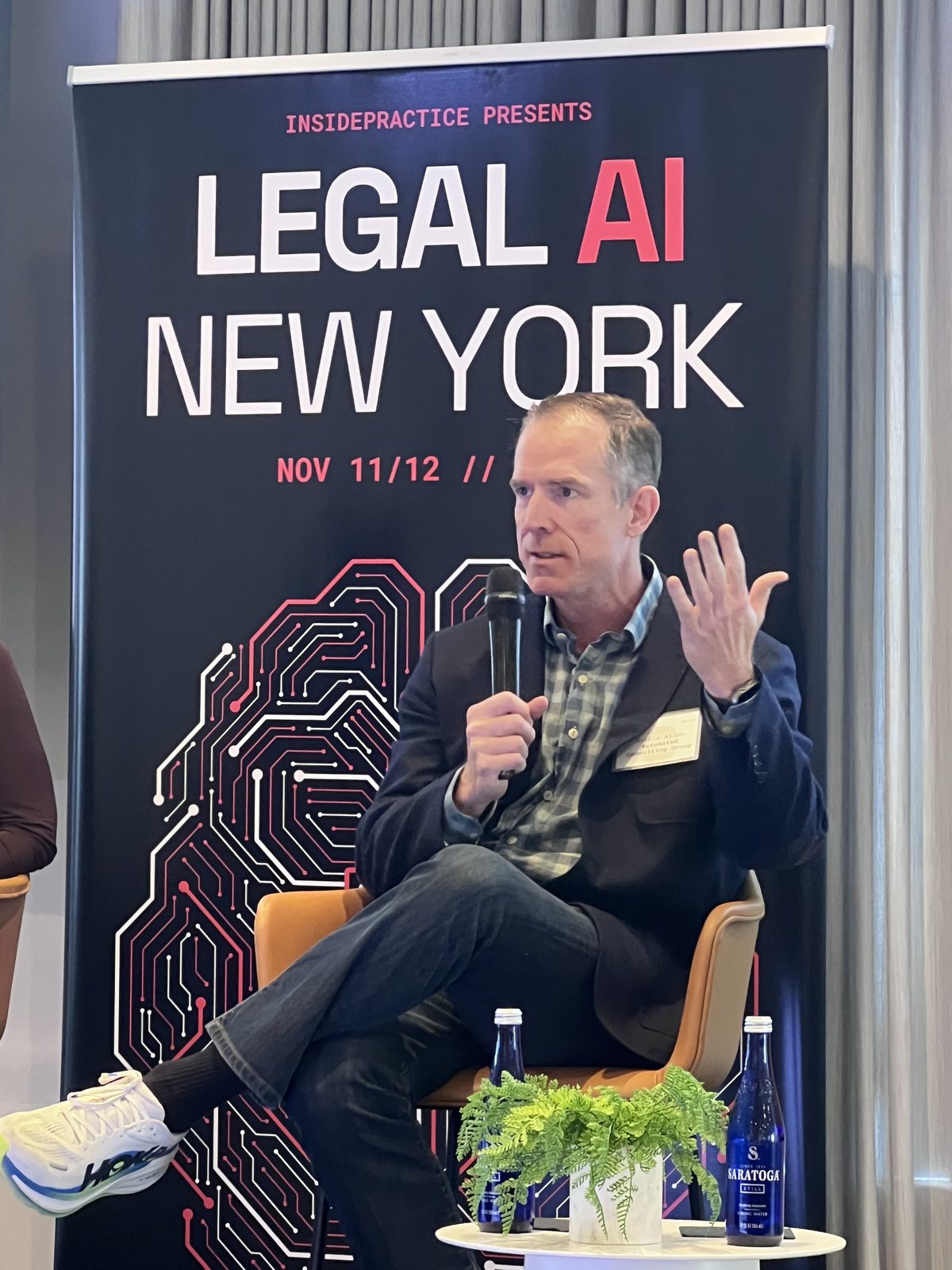
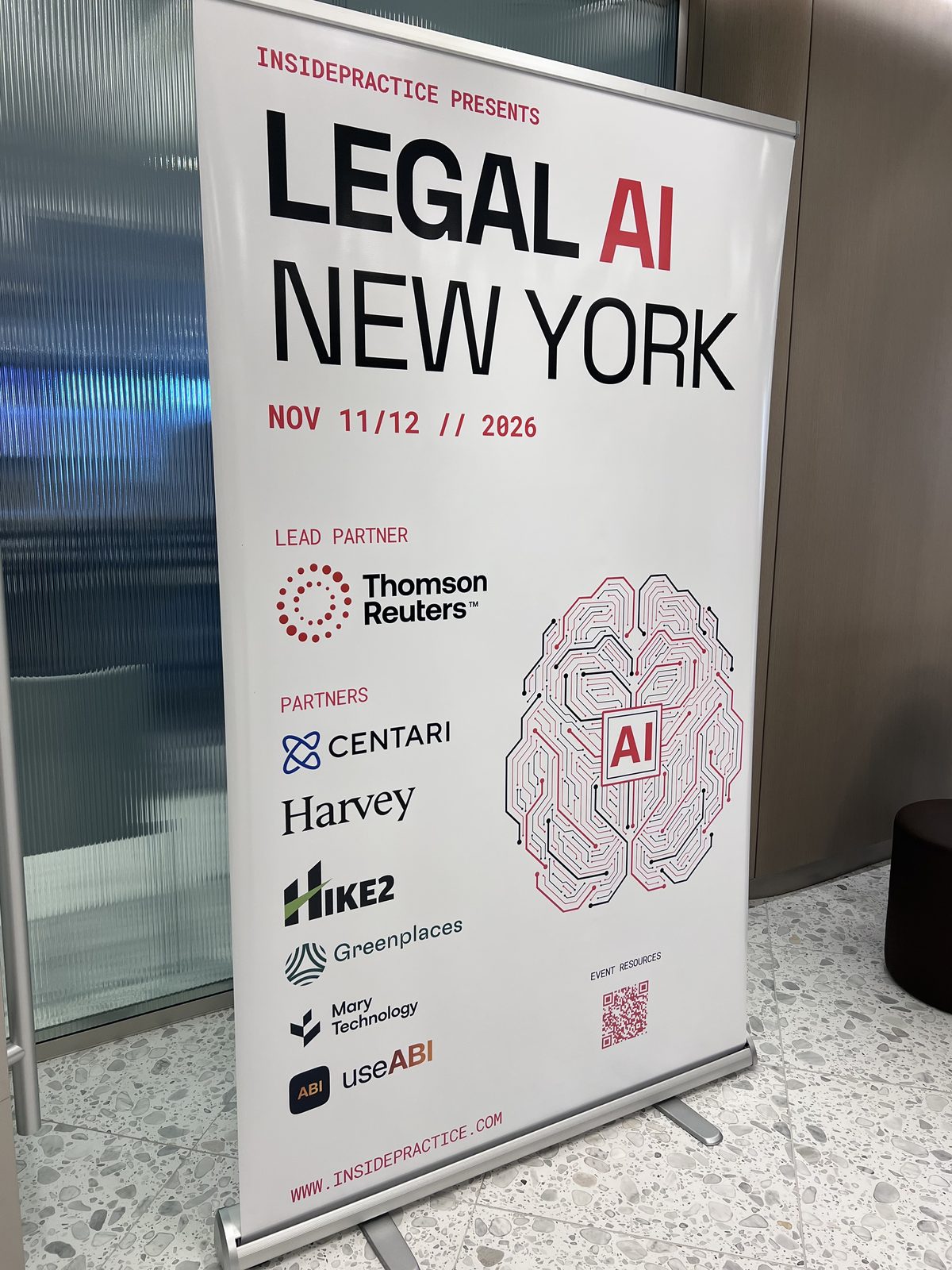
The room on Day 1.During the panel.The Inside Practice banner.
Session by session
Two points from each talk, in the order they ran. Speakers and firms are as listed on the published agenda.
Day 1, Wednesday, November 11
Chairperson’s opening remarks
Tommy Williams, Thomson Reuters
More than nine in ten professionals say their organization falls short of what AI could deliver. The gap is strategy, not access.
A third use tools their organization has not approved. Shadow AI is a symptom of inaction: the approved tools or the guidance are not good enough.
The legal engineer needs three things: how legal work gets done, the ability to build, and the ability to get people to change.
McGuireWoods: “We’re hiring six, and I need all six to succeed.” Its candidates take an in-room written test with no AI.
Beyond AI Productivity: Proving Client ROI Through Agentic Workflows
Scott Angelo, Faegre Drinker; Arup Das and Catherine Krow, HIKE2
Asked how much faster the work got, the lead partner corrected the question. The point was a capability the firm never had.
Most of the agentic work was data: 70 to 80 vendor formats turned into one taxonomy. Run it as a product, not a project.
Who Audits the Law Firm? Proving AI Governance to the Clients Who Demand It
Amanda Grady, Greenplaces; Warren Thomas, Capitol Broadcasting Company; Mary Beth Marchione, Wipfli; Robbie Allen, Automated Consulting Group
A general counsel who works with 30 to 40 firms said he couldn’t think of one that had raised AI governance proactively. Missing proof is becoming an RFP disqualifier.
Clients want SOC 2 Type 2 because it tests operation over time. Say you review access quarterly and the auditor asks for Q1 and Q3.
My point: once a firm gives clients a tool it built, “guess what? You’re the vendor now.” Every control and all the evidence move in-house.
Where the Money Went: Four Years of Law Firm AI, From the Client’s Side
Kevin Walker, Centari
Voting as general counsel, the room put “my bill should go down” first and “reduce partner distributions” last.
Abdulrasheed Ijaodola, useABI; Rachel Shields Williams, Bass, Berry & Sims; Julia Montgomery, King & Spalding
Usage is logins. Adoption is behavior change toward a defined goal. Enablement is the work in between.
Adoption is a capacity problem. One firm scores every change request and limits how much change ships in a quarter.
Case Study: Building the AI Dream Team
Kathleen Jimenez, Rajesh Bagga, Dharma Frederick, and Leigh Zidwick, DLA Piper
DLA says 85% of its attorneys are trained in and actively using AI, with 100% of associates in many practice groups.
Every client AI questionnaire routes through one list and a pre-approved playbook. “Spot check” is not a standard; statistically valid sampling is.
Day 2, Thursday, November 12
The Business Case for AI: Measuring Value, Pricing Innovation, Building Trust
Emily Lonsdale, Mary Technology; Khader Hawa, Michael Best; Matt Bruck, Mound Cotton Wollan & Greengrass; Madhav Srinivasan, The Wharton School
A BigHand survey this summer found 31% of respondents had seen profit gains from AI-enabled matters.
Niche tools whose cost passes through to clients are easier to justify at a mid-sized firm. General AI subscriptions come out of partner profits.
The Human + Machine Advantage: Designing AI That Lawyers Will Actually Use
Inna Jackson, Tensec; David Curran, The Great Atlantic; Liz Paisner, General Legal
The biggest barrier is awareness of what AI can do. Lawyers who have only used AI inside a Word plugin assume it is limited.
A managing partner with no coding experience built a CLE-status bot in about 30 minutes. That first “I don’t need any skills to get started” experience can be the turning point.
Case Study: The Evolution of AI in Litigation
Scott Kaiser, Mayer Brown; Kate Machan, Gibson Dunn; Mike Ertel, Crowell & Moring
Litigation AI moved from e-discovery to drafting, but general tools get, at best, 75 to 80 percent of the way to a finished product. The lawyer owns the rest.
Clients went from “we don’t want to use AI on our matters” to “how will you use it?” Some RFPs ask for a budget with and without it.
Knowledge Management Reimagined
Michael Korn, McDermott Will & Schulte; Julia Montgomery, King & Spalding
Year two: renewals are due and pricing is changing, so which business problem and what return are now unavoidable questions.
“We send emails and we run training classes, and that really is not change management.” Firms still have thousands of files named “document.”
From AI Efficiency to Client Value: Redefining Legal Services
Kristin Lorieo and Zorik Pesochinsky, Pillsbury Winthrop Shaw Pittman
Cooley turned a routine fund-interest transfer into a $495 flat-fee product. The point was not the revenue. It was keeping the relationship.
The reframe that works with skeptics is not “is this perfect” but “is this a better starting point.”
Not covered: the Day 2 closing panel, Leading Through the Next Wave of AI, which was not recorded.
Sources: recordings of each session, checked against the published agenda. Statistics are as cited on stage; the Thomson Reuters figures are from the 2026 Future of Professionals report. Corrections to robbie.allen@automated.co.